



HHS Peptide Policy Explained: Big News for the EllieMD Community


EllieMD
November 2, 2026
5 min read
We have big news, and we're so happy to share it with you first! On Oct. 28, 2026, the U.S. government shared a new policy about six peptides. It moves in the direction you asked for: a supervised path, with licensed doctors and pharmacies involved. We're so proud of what this community did this summer.
Below is everything in plain words. It covers what the policy says, what it means, and what it doesn't. We love celebrating with you, and we want you to have the facts too.
THE SHORT VERSION
- On Oct. 28, 2026, a part of the U.S. government called HHS shared a new policy about six peptides. They are BPC-157, TB-500, KPV, MOTS-c, Semax, and Epitalon. (HHS is short for the U.S. Department of Health and Human Services.)
- HHS says it doesn't plan to step in against licensed pharmacies and doctors who make these peptides for patients, as long as they follow the policy's safety rules.
- This is not FDA approval. By law, no compounded medications, including any of these six peptides, are FDA approved.
- The policy is a draft. HHS can change it, and the public can share comments until about Nov. 13, 2026.
- Nothing changes for current EllieMD orders. A licensed provider decides what's right for you.
Our summer in Washington, D.C.
This summer, speaking up for safe, supervised access to peptides became one of the biggest efforts EllieMD has ever taken on. Our community went to Washington, D.C., with signs, matching shirts, and so much heart.
Our founder and CEO, Hanieh Sigari, addressed the FDA's advisory committee in July. Drawing on her background in biochemistry and gerontology (the study of aging), she spoke up on several key peptides, advocating for patients everywhere, doctor supervision, and greater accountability across healthcare. Right alongside her, many of the EllieMD community rallied in support.
Her message was simple. She asked for a path for patients guided by doctors. She asked for ingredients from registered facilities, tests on every batch, and reports when something goes wrong. In her words: "Give patients a supervised path. Keep physicians in the room. Let us build the evidence together."
Many of those safeguards show up in the policy HHS just shared. While we can't say what moved any one decision, we can say that our community was there, and the policy now points in the direction you advocated for. Thank you. Every story, every voice, and every person who showed up mattered to us.
Who is HHS, and what did it announce?
HHS stands for the U.S. Department of Health and Human Services. It's the part of the federal government that works on health. The FDA, which stands for the Food and Drug Administration, is one of its agencies. The FDA is the group that approves medicines.
On Oct. 28, 2026, HHS filed a notice called "Enforcement Discretion Policy Regarding 503A Compounding Using Certain Peptide Bulk Drug Substances." The Federal Register, which is the government's daily public notebook, published it on Oct. 30, 2026. Its docket number is HHS-OASH-2026-0496. HHS Secretary Robert F. Kennedy, Jr. signed it.
The policy names six peptides. HHS says it doesn't plan to take action against a pharmacy licensed by a state, a federal facility, or a licensed doctor who prepares medications using any of these six peptides. Recognizing significant patient interest and a current lack of FDA approved alternatives, HHS stated its goal is to expand and improve patient access while formal FDA rules are finalized.
What are peptides?
Peptides are short chains of amino acids. Amino acids are the small building blocks that make up protein. Your body makes many peptides on its own. Scientists also make peptides in labs.
What does "enforcement discretion" mean?
It means a government agency decides not to step in, in certain cases. It doesn't change the law. It doesn't approve a medicine. HHS said it can take another look at the policy at any time. For example, it might do that if a safety problem shows up.
What is compounding?
Compounding is when a licensed pharmacist or doctor makes a medicine for one person. They do it based on that person's prescription. A federal law, called section 503A, sets the rules for pharmacies that do this.
Compounded medicines are not FDA approved. The FDA doesn't check them for safety, effectiveness, or quality before people use them.
Under that law, a pharmacy can usually only use ingredients that pass one of three tests. The ingredient is in an official book of drug standards, called the USP. Or it's part of an FDA approved drug. Or it's on the FDA's 503A "bulks list," which is a list of ingredients pharmacies are allowed to use. The six peptides aren't on that list yet. That's why this policy matters to pharmacies.
Which peptides does the policy cover?
The policy covers six peptides. It also names the form and the way each one is taken. Here's the list from the policy's Appendix A.
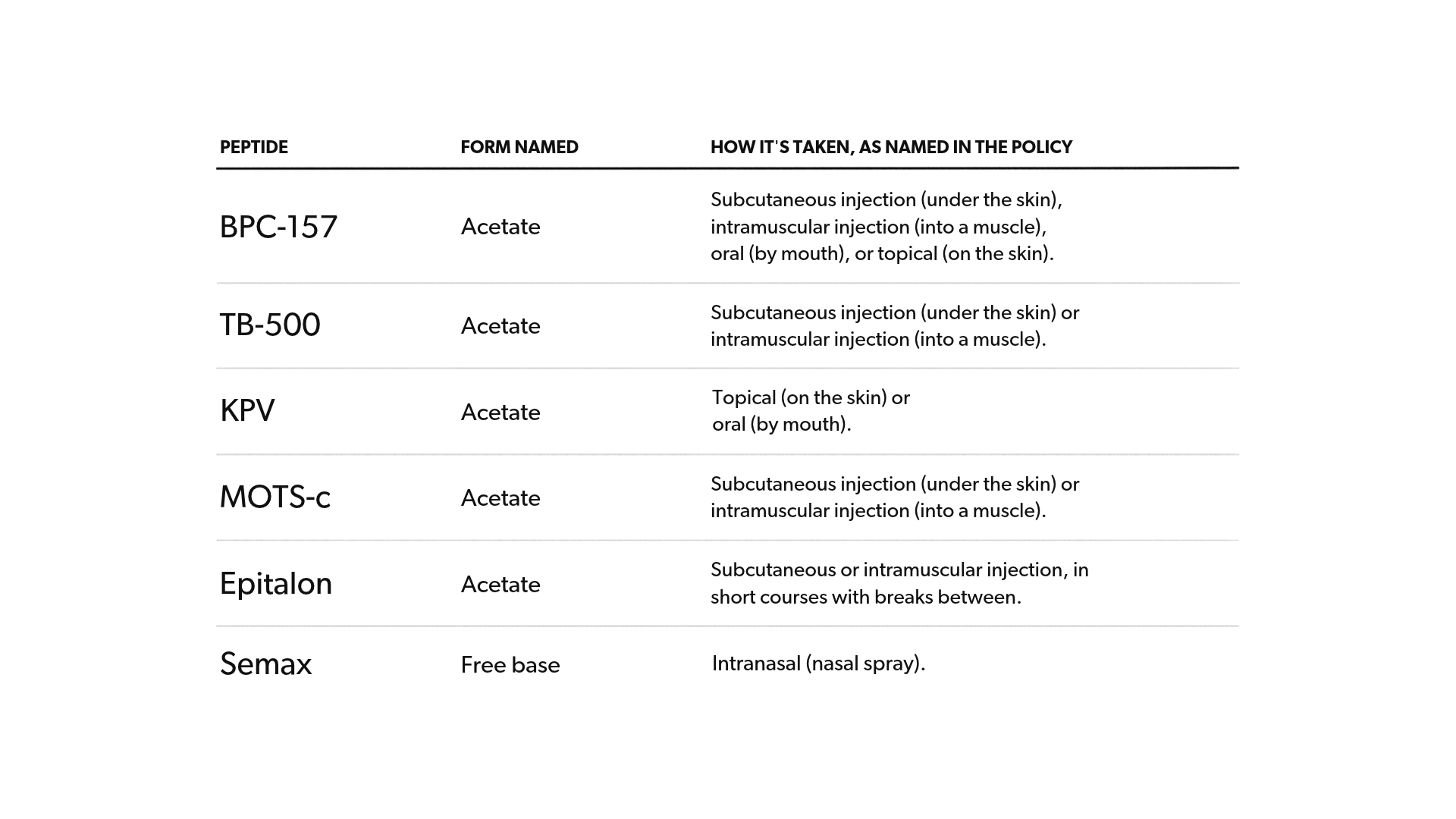
The policy only covers a medication that has one of these peptides in it. A medication that mixes the peptides together isn't covered, as the policy is written. It also doesn't cover large outsourcing facilities, which fall under a different rule, section 503B. For details on the exact specifications, read the policy itself.
What do pharmacies have to do?
The policy comes with rules, and pharmacies and doctors have to meet them. In general, they have to:
- Make the medicine for one patient, with a valid prescription.
- Use peptide ingredients from an FDA registered facility, with a paper that shows what's in it (a certificate of analysis).
- Test each batch, including checks for what it is, what else is in it, and toxins made by bacteria (bacterial endotoxins).
- Follow the U.S. drug standards and the other 503A rules, including how the medicine is labeled.
- Report safety problems.
The policy has 10 rules in all, according to AJMC, a health news site. You can read every one in the policy itself.
What this policy does not do
- It doesn't approve any peptide. HHS said so clearly.
- It doesn't put the peptides on the 503A bulks list. The FDA still has to write that rule, and it asks the public for comments first. That can take a long time.
- It isn't final. It doesn't give anyone legal rights, and HHS can change it.
- It doesn't show that these peptides work. A rule about who may make a medicine doesn't tell us if the medicine helps. Much of the research on these peptides is still early, and there are few large studies in people.
- It doesn't cover other peptides. Only the six in the list are included.
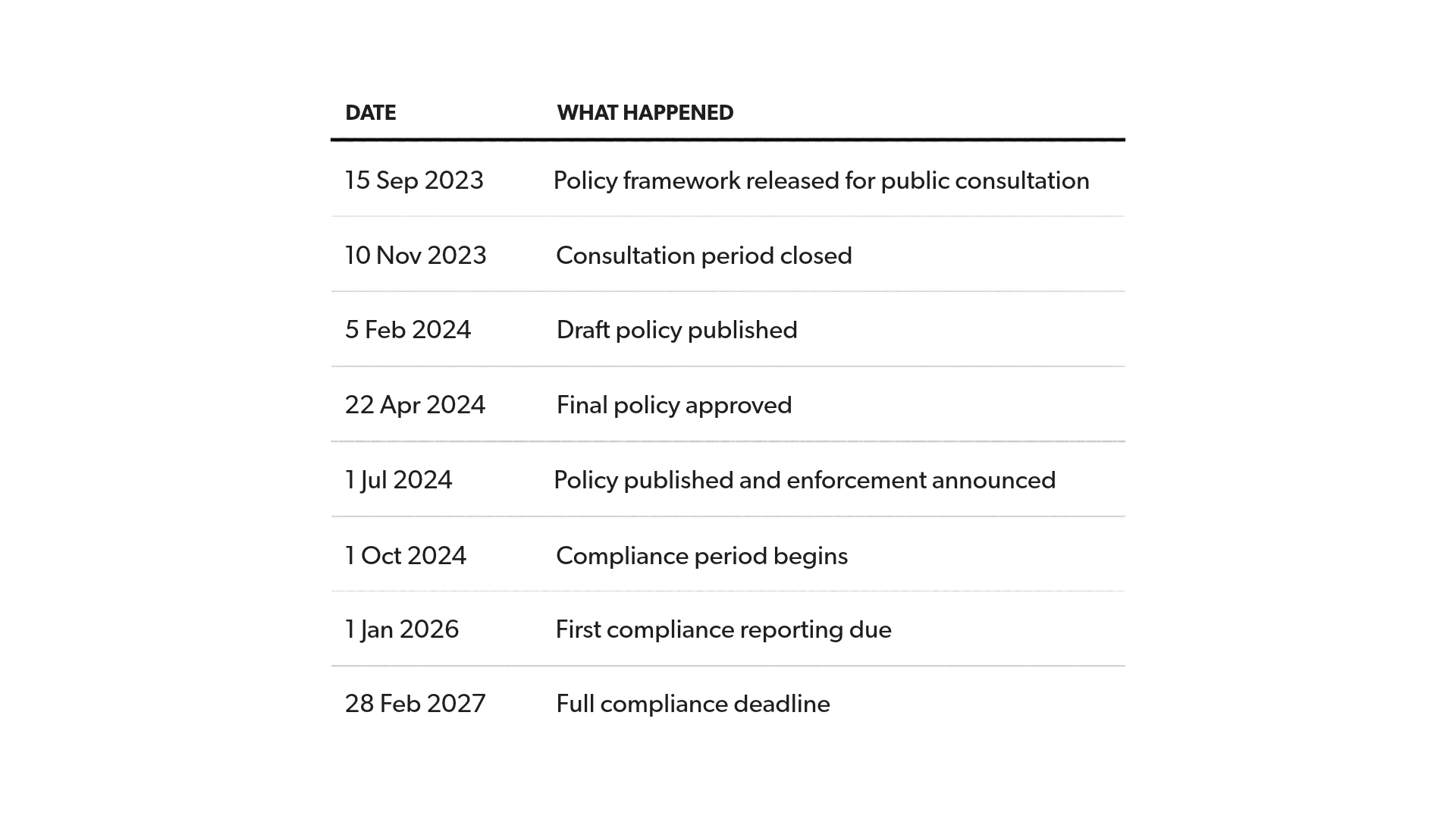
How did we get here?
What does this mean for you?
You may be wondering how this fits into your own plan. Here's what it means for you. When you join EllieMD, you can talk with a licensed provider online, from wherever you are. That provider is independent, and they decide if a prescription is right for you. If it is, a licensed pharmacy makes your medicine just for you. EllieMD is the platform that brings it all together. We're not a healthcare provider, but we're with you every step of the way.
Good news first: this policy doesn't change your current order or prescription, and you don't need to do anything. The team at EllieMD is looking at each product to see how it fits the policy. Some products, like ones that mix more than one peptide, aren't covered in this specific policy. Your provider can tell you what applies to you. You can message them in the Patient Portal.
If you'd like to learn about the programs a provider can prescribe, visit our peptide programs page at elliemd.com/longevity.
What happens next?
- Public comments. Anyone can share a comment on regulations.gov, Docket No. HHS-OASH-2026-0496, until about Nov. 13, 2026.
- FDA rules. The FDA may propose adding some or all of the six peptides to the 503A bulks list.
- Changes to the policy. HHS can change or end it, for example if a safety problem shows up.
We'll update this post as things happen.
Thank you, EllieMD family
This one belongs to you. You made signs. You showed up. You shared your stories, and you trusted us to carry them. There's more work ahead, and we'll keep doing it together, with doctors in the room and safety first. We're so grateful to be on this road with you.
Frequently asked questions
Did the FDA approve BPC-157 or the other five peptides?
No. None of the six peptides is FDA approved. The HHS policy isn't an approval. It says HHS doesn't plan to step in against licensed pharmacies and doctors who make them under the policy's rules.
What is HHS?
HHS is the U.S. Department of Health and Human Services. It's the part of the federal government that works on health. The FDA is one of its agencies.
Who announced the policy, HHS or the FDA?
HHS announced it. HHS Secretary Robert F. Kennedy, Jr. signed the notice. The FDA is working on its own rules for the 503A bulks list.
Are these peptides legal now?
Not exactly. "Enforcement discretion" means HHS has chosen not to step in. It doesn't make a medicine legal or approved. The six peptides still aren't on the FDA's 503A bulks list.
Is the policy final?
No. HHS calls it a draft. The public can share comments until about Nov. 13, 2026. HHS can change or end the policy.
Does the policy cover medicines that mix peptides?
Not as it's written. It covers a medicine that has just one of the six peptides in it.
Does the policy cover every form of each peptide?
No. It names one form and certain ways to take each peptide. For example, it names KPV for use on the skin or by mouth, and Semax as a nasal spray.
Does this mean the peptides work?
No. The policy is about who can make these medicines. It doesn't say if they work. Much of the research is still early.
What is the difference between a compounded peptide and a "research use only" product?
A pharmacy makes a compounded peptide for one patient, with a prescription from a licensed provider. A "research use only" product is sold as a lab chemical. It has no prescription, no pharmacist, and no testing rules for use in people.
Does this change my current EllieMD order?
No. Nothing changes for your current order or prescription. You don't need to do anything.
What did EllieMD do to support this policy?
Hanieh Sigari, EllieMD's founder and CEO, spoke at the FDA's advisory committee meetings in July, and many members of the EllieMD community rallied in support in the Washington, D.C., area. Nobody can say how much any one effort changed the outcome, but the policy points toward the supervised path our community asked for.
How do I know if a peptide is right for me?
Ask a licensed provider. EllieMD customers can message their provider in the Patient Portal. Providers know your health history and can talk through your options.
How can I share a comment on the policy?
Go to regulations.gov and open Docket No. HHS-OASH-2026-0496. Comments are open until about Nov. 13, 2026.
Sources
- HHS, Enforcement Discretion Policy Regarding 503A Compounding Using Certain Peptide Bulk Drug Substances, Federal Register, Oct. 30, 2026, FR Doc. 2026-22192, Docket No. HHS-OASH-2026-0496. federalregister.gov/d/2026-22192
- HHS, policy text with Appendices A and B. hhs.gov/sites/default/files/hhs-503a-peptide-enforcement-discretion-policy-appendix-b.pdf
- Public comments: regulations.gov, Docket No. HHS-OASH-2026-0496
- AJMC, HHS Draft Policy Eases Enforcement on 6 Compounded Peptides, Oct. 2026
- Frier Levitt, HHS Peptide Compounding Enforcement Discretion Policy, Oct. 2026
- American Med Spa Association, HHS Announces Interim Enforcement Discretion for Six Peptides, Oct. 2026
Compounded medications are not FDA approved, and the FDA does not review them for safety, effectiveness, or quality. EllieMD is a telehealth platform. Eligibility and prescribing decisions rest with independent licensed providers. This article is for information only and is not medical advice.
Related Articles

NAD+ Nasal Spray vs IV Therapy: A Clinical Comparison
EllieMD

Starting Longevity Medicine in Your 30s: Why Earlier Changes the Outcome
EllieMD

The Longevity Case for Resistance Training: What the Research Actually Shows
EllieMD

Sermorelin vs. HGH: Which Is Better for Longevity?
EllieMD

Methylene Blue for Brain Health: Cognitive Benefits and What the Research Shows
EllieMD
NAD+: Benefits, How It Works, and Delivery Methods Explained
EllieMD
Get the latest updates and exclusive offers by subscribing to our newsletter.
© 2026 EllieMD LLC. All rights reserved.
